London Charterhouse
Wolf HallLondon Charterhouse is an austere religious house whose monks’ resistance to the king’s claims over the church brings the conflict between royal and spiritual authority into a concrete, local setting. Thomas Cromwell visits the community, tries several forms of persuasion, and fails to change its members’ decision; their refusal ultimately exposes them to the law’s treatment of disobedience as treason.
A Community in Conflict
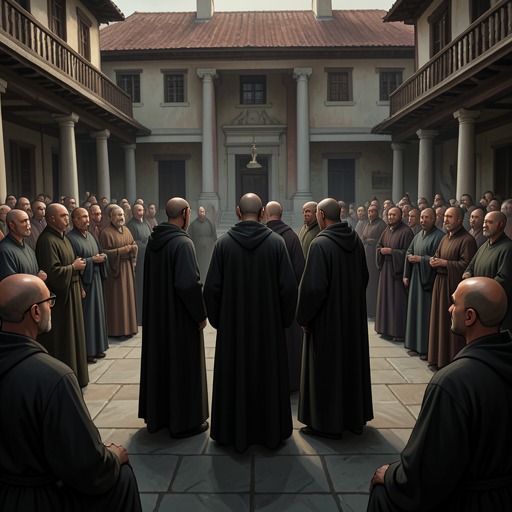
The Charterhouse of London is described as the place where the “mischief” originates: a community of men living austerely and sleeping on straw. The novel also recalls that Thomas More tried his vocation there before deciding that the world needed his talents. The house therefore carries associations both with religious withdrawal and with a path that More himself did not follow.
Cromwell’s Efforts to Persuade the Monks
Cromwell has visited the London Charterhouse as well as the resistant community at Syon. He speaks gently and bluntly, threatens and cajoles, sends reform-minded clerics to argue for the king’s position, and interviews dissenting members in an effort to turn them against their brethren. None of these measures secures the community’s agreement. The monks insist on being left to their religious calling, making clear that the dispute cannot be resolved simply by presenting the Crown’s case more forcefully.
Royal Authority and Conscience
The wider dispute concerns who has jurisdiction over the church in England. In conversation with Henry VIII, Cromwell advances the arguments associated with Marsiglio of Padua: priests are subjects, while secular government determines matters such as marriage and legitimacy through law and Parliament. Later, when Richard Riche reports his conversation with More, More distinguishes Parliament’s authority over temporal government from spiritual jurisdiction, which he regards as lying beyond the realm. The Charterhouse’s resistance belongs to this same struggle over whether the king’s authority can settle religious obligations.
Refusal and Consequence
The monks are offered the oath repeatedly and refuse it. A year after Elizabeth Barton’s execution, four monks are put on trial; the novel presents the Charterhouse as the source of the resistance that the Crown now treats as a legal and political threat. Cromwell’s attempts at negotiation have failed, and the law’s severe treason penalty hangs over the proceedings. The house thus marks the point at which religious dissent, conscience, and royal policy meet in a conflict with life-threatening consequences.